Using AI for Content Research Without Losing Your Voice
How writers and teams can use AI for content research while preserving judgment, originality, and editorial voice.
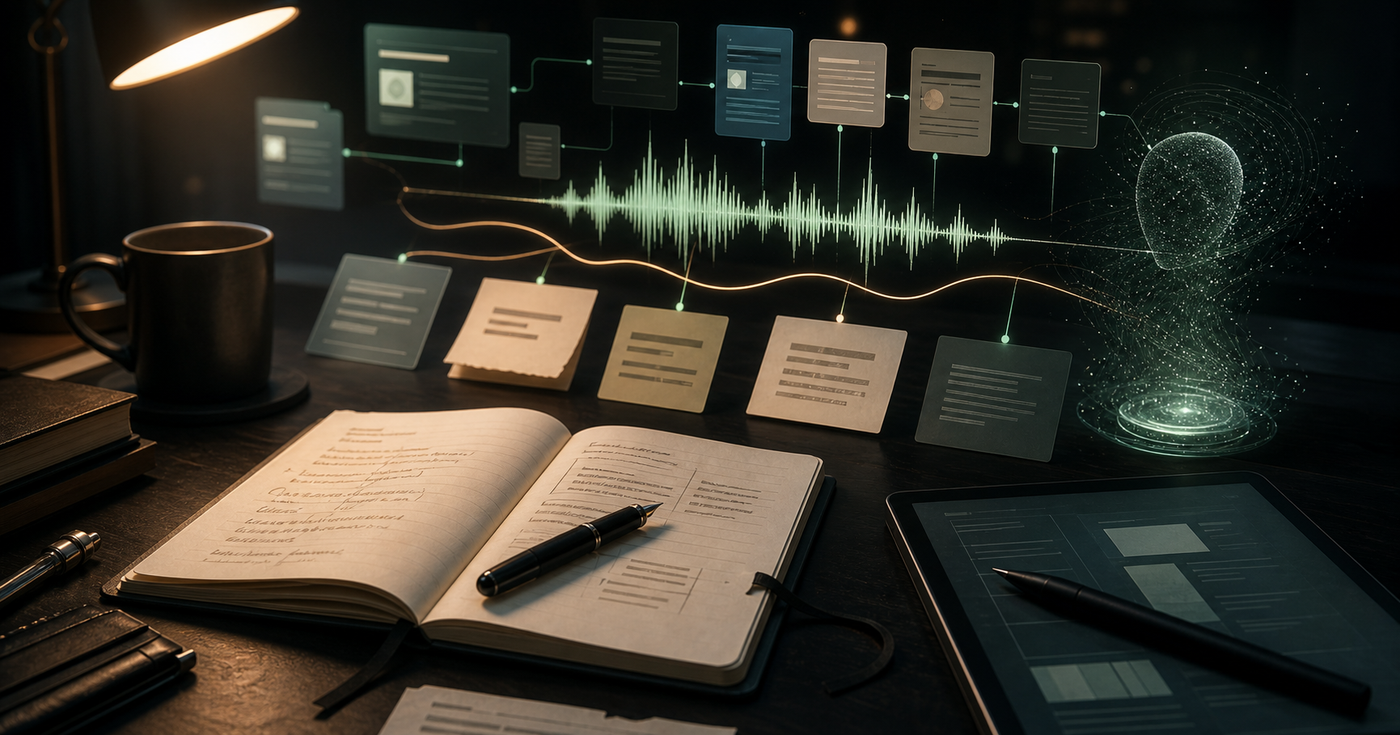
AI can make content research faster, but it can also flatten everything into the same confident, average-sounding article. The difference comes from how you use it. If the model writes before you have a point of view, the output tends to drift toward generic advice. If you use it to organize research, pressure-test structure, and surface gaps, it can make your own voice clearer.
The goal is not to outsource thinking. The goal is to reduce the mechanical load around thinking: sorting notes, summarizing long sources, comparing angles, finding missing questions, and turning rough ideas into an editable structure.
Start With Your Thesis
Before opening an AI tool, write the claim you want to explore in one or two sentences. It can be provisional, but it should be yours. This gives the research a direction and prevents the model from deciding the article for you.
A thesis also makes the final piece easier to evaluate. You can ask whether every section supports, complicates, or challenges that claim. Without a thesis, AI-assisted research often becomes a pile of plausible points with no editorial center.
Use AI to Organize, Not Invent Evidence
AI is useful for grouping notes, extracting themes from interviews, turning messy bullets into outlines, and identifying unanswered questions. It is less reliable as a source of facts unless you provide the sources and verify the claims yourself. Treat unsupported facts as leads, not evidence.
A strong workflow is source-first. Collect articles, transcripts, product notes, support tickets, or interview excerpts. Then ask the model to summarize only that material, quote or reference the relevant source names, and call out uncertainty. This keeps research anchored in real inputs.
Protect Your Voice in the Outline
Voice is not only word choice. It is what you notice, what you ignore, how you sequence ideas, and where you are willing to be specific. If you let the model create the outline from scratch, you may inherit a structure that sounds polished but says little.
Draft your own rough outline first, even if it is ugly. Then use AI to identify gaps, reorder sections, suggest stronger transitions, or produce alternate structures. You keep editorial control while still benefiting from fast iteration.
Ask for Counterarguments
One of the best research uses for AI is disagreement. Ask what a skeptical reader would challenge, what examples would weaken your point, what terms need definition, and where the argument sounds too broad. This makes the article sharper before you spend time polishing sentences.
Counterarguments also reduce the risk of overconfident writing. A piece that acknowledges nuance usually feels more human because it reflects judgment. It shows the reader that the author has considered the hard parts rather than smoothing them away.
Rewrite the Final Draft Yourself
AI can help with sentence-level alternatives, but the final pass should restore your rhythm. Read the draft out loud, cut filler, replace vague abstractions with concrete examples, and remove phrases you would not say. The fastest way to lose your voice is to accept fluent sentences just because they are fluent.
Used well, AI becomes a research assistant, not a ghostwriter. It helps you move through raw material faster, see gaps sooner, and test structure with less effort. The finished piece should still sound like someone with a real stake in the subject wrote it.
Related Posts

Practical AI Workflows for Small Teams
A practical guide to using AI in small teams without adding process debt, tool sprawl, or review gaps.

How to Evaluate AI Tools Before You Adopt Them
A grounded framework for judging AI tools by workflow fit, privacy, reliability, review cost, and total ownership cost.

AI Prompting Patterns That Save Real Time
Reusable AI prompting patterns for better briefs, clearer constraints, stronger reviews, and less back-and-forth.